Ranking · Conversion
By Marc, Pulse Pilot
·
4 min read
From the team at Pulse Pilot — Amazon PPC software that runs your bids by your rules (Pilot) or fully hands-off (Autopilot).
“Run more ads, it’ll help you rank.” Every seller has heard it. Sometimes it’s true. Sometimes it burns a few thousand dollars and the product sits on page three anyway.
The difference usually comes down to two numbers most sellers never compare.
How ranking actually works (the short version)
Amazon ranks the products that sell for a search, consistently. That’s sales velocity: units sold on a search, day after day. Velocity comes from three things multiplied together:
Shoppers who see you × how many click (CTR) × how many of those buy (CVR)
Ads buy the first part. They put you in front of more shoppers.
CTR is decided by what shows in the search results: main image, price, star rating, review count, title.
CVR is decided by your listing and offer once they click.
Ads can only push the first number. If your CTR or CVR is below the products around you, every extra impression you buy produces fewer sales than theirs, so they keep outselling you and your rank stays put.
If you click or convert below the market, more ad spend buys exposure, not rank.

Ads move the first number. Your listing decides the other two.
The two checks: CTR and CVR vs. the market
1. Conversion rate first. It’s the bigger lever, and it’s where ad money disappears fastest, because you pay for every click that doesn’t buy.
Below the market: don’t scale ads yet. Fix price, images, reviews, the A+ content and the offer.
About even: ads can help. Steady spend on your best searches builds velocity over weeks.
Above the market: you’re under-exposed. Push bids on the searches where you convert best.
2. Then click-through rate. If shoppers see you but don’t click, the problem is what shows in the search results, before anyone reaches your listing:
The main image doesn’t stand out in a row of similar products.
The price is visibly higher than the products next to you.
The star rating or review count is weaker than page one.
Low CTR caps your velocity even when your conversion rate is great, because too few shoppers ever reach the listing.
Not sure why your product isn't ranking?
We'll show you how your listing converts next to the market, before you spend more on ads.
No credit card
Ads access only
Changes nothing in your account
From a real account
One of our own products, Product A, sells in a crowded replacement-parts category.
Its conversion rate: 22.3%. The market’s: 34.2%. It converts at about two thirds of the market.
Ads put it in a top-20 sponsored spot on its main search on 16 of the last 60 days.
Its organic rank on that search sat at #48 or worse on 50 of those 60 days (median position: #61). It reached the top 10 on only a handful of scattered days.
The ads did their job: they bought visibility. The rank didn’t follow, because every click converted worse than the listings around it. Raising bids would only have bought more of the same clicks. The fix for Product A is the listing and the offer, not the bid.
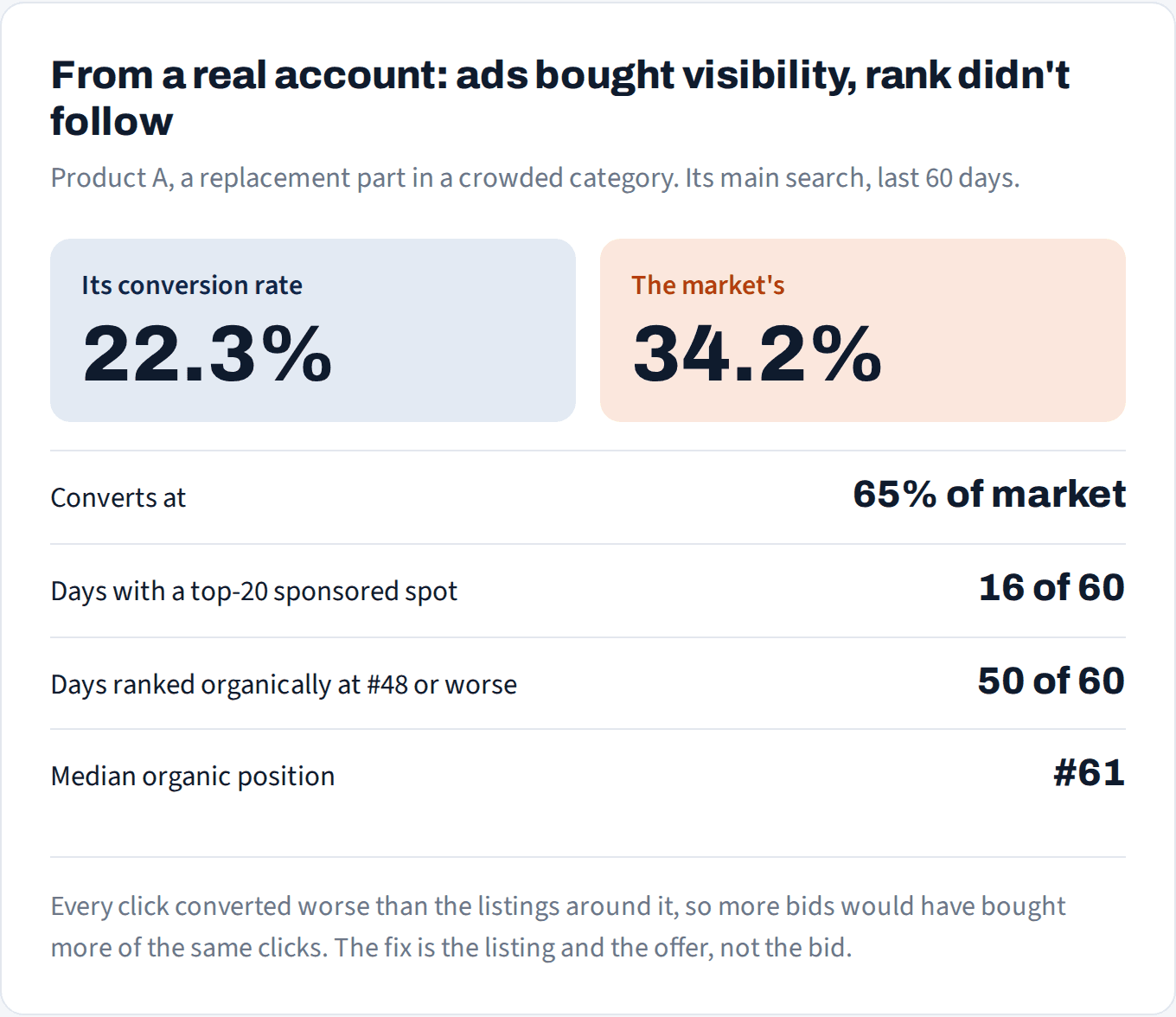
From a real account: 60 days on the product's main search.
Other reasons a product won’t rank
Clicks and conversion are the big ones, but rule these out too:
You’re not indexed for the search. If the words aren’t in your title, bullets or backend keywords, Amazon may not show you organically at all.
The listing is new. With little sales history, rank takes time even when everything else is right.
Stockouts. Running out resets momentum, and rank often drops for a while after you’re back.
Check whether it’s working
Whatever you change, track your organic position on your main searches every day, and look at the trend over 2–4 weeks. Single days jump around: Product A’s rank swings 20+ positions overnight. If your click and conversion rates move up toward the market and rank is still flat after a month, look at indexing next.
How to check this in Pulse Pilot
Keyword Manager shows Market CVR next to your CVR on every keyword. Pulse Pilot’s market benchmark comes from our own proprietary data, so you can see where you’re below the market and where you’re beating it.
Sales Funnel shows where you lose shoppers, at the click or at the purchase, compared with the market.
Rank Tracker follows your organic and sponsored position on the searches you choose, every day.
Rules can use organic rank as a condition. For example, push bids only on keywords where you convert at or above the market and haven’t reached the top 5 yet.
No tool can promise you rank. What it can do is tell you whether more ad spend can help, before you spend it.